

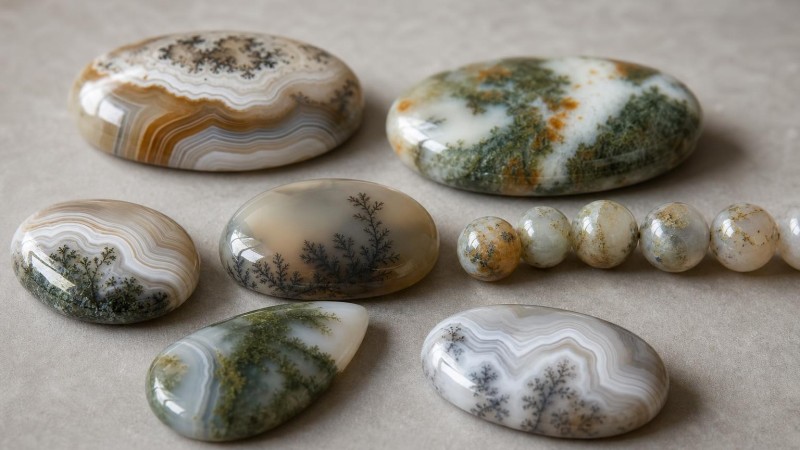
Agate is one of the most varied materials in the gemstone world. One specimen may display orderly ribbons of color, another can resemble a miniature forest, and another may contain branching patterns that look as though a fern has been preserved inside the stone. These appearances have inspired names such as banded agate, moss agate, and dendritic agate.
Although these varieties are closely related, their patterns form in different ways and can create very different effects in jewelry. Understanding those differences makes it easier to identify agate, choose beads or cabochons, plan designs, and appreciate what natural inclusions reveal about the stone's formation.
What Is Agate?
Agate belongs to the chalcedony family. Chalcedony is a microcrystalline form of silica, composed primarily of extremely fine quartz crystals. Unlike transparent rock crystal, its crystals are so small that they cannot normally be distinguished with the unaided eye. This fine structure gives chalcedony its characteristically smooth, waxy appearance.
In the traditional gemological sense, agate is especially associated with chalcedony showing bands, layers, or other distinctive patterning. However, the gemstone trade also uses long-established variety names such as moss agate and dendritic agate for chalcedony whose visual identity comes from inclusions rather than classic banding.
Many agates originate when silica-rich fluids enter cavities or fractures in rock and gradually deposit chalcedony. Changes in mineral content, chemistry, and conditions during formation can produce layers of different colors and translucencies. Other specimens incorporate mineral inclusions that develop into mossy or branching forms.
Agate is also practical for jewelry making. With a Mohs hardness around 6.5 to 7, it is sufficiently durable for many everyday jewelry applications, although it can still chip or fracture under a hard impact. Polished agate beads are especially useful when a designer wants natural pattern, subtle color variation, and a smooth finish.
Banded Agate: Layers Written in Stone
Banded agate is the variety that most clearly demonstrates the layered structure traditionally associated with agate. Its parallel, curved, angular, or concentric lines can alternate between translucent and opaque material or shift through white, gray, brown, red, black, and other colors.
How Banded Agate Forms
Many banded agates develop through repeated silica deposition within a cavity. Successive layers may differ slightly in color, mineral impurities, crystal structure, or translucency. Over time, the accumulation creates visible bands. When a geode or nodule is cut across these layers, complex concentric patterns can appear.
The geometry varies considerably. Fortification agate has angular bands that can resemble the outlines of an old fortress. Some stones show delicate parallel stripes, while others contain dramatic concentric zones. This variety means that cutting orientation matters: two slices from the same rough specimen can reveal noticeably different compositions.
Color deserves careful attention when selecting banded gemstone beads. Natural agate can be understated or vivid, but agate is also commonly dyed because porous portions of the material may accept color well. Dyed agate is legitimate decorative material when accurately described; the important distinction for buyers and makers is whether color has been enhanced.
Designing With Banded Agate
Strong banding already provides visual movement, so simple jewelry arrangements can showcase it effectively. Large focal beads or cabochons let broad patterns remain visible, while smaller beads can create rhythmic stripes throughout a necklace or bracelet. Rotating individual beads before stringing is a useful way to decide which face displays the most attractive bands.
For a balanced design, consider repeating one of the quieter colors found inside the agate. Neutral metal spacer beads, for example, can separate heavily patterned stones and prevent neighboring patterns from visually competing. Photographing a layout before assembly can also help you compare sequences without repeatedly restringing the piece.
Moss Agate: Landscape-Like Inclusions
Moss agate looks remarkably botanical, but it does not contain fossilized moss or other plant matter. Its green, brown, black, or reddish inclusions are mineral formations within chalcedony. They may resemble moss, grasses, clouds, underwater plants, or distant landscapes, giving each piece a highly individual appearance.
Unlike classic banded agate, moss agate usually lacks obvious concentric banding. The historical name persists because the material has long been grouped with ornamental agates in the gem trade. Depending on the specimen, the chalcedony host may be nearly transparent, cloudy white, bluish, or softly translucent.
Why Moss Agate Looks Organic
The moss-like appearance results from mineral inclusions, commonly involving manganese or iron compounds and, in some material, green minerals such as chlorite or celadonite. These inclusions can occupy fractures or grow in irregular forms, creating the illusion of vegetation suspended inside the stone.
Translucency is particularly important to the visual character of moss agate. Light entering the chalcedony can reveal inclusions at different apparent depths, producing an almost three-dimensional scene. This effect makes polished cabochons, flat beads, and larger focal stones especially appealing.
Using Moss Agate in Jewelry
Because each piece differs, sorting before designing is worthwhile. Place the stones on a light neutral surface and compare their transparency, inclusion density, dominant colors, and orientation. For symmetrical earrings, seek pieces with similar visual weight rather than expecting identical natural patterns.
Moss agate pairs comfortably with understated materials because its inclusions are already detailed. A simple setting or restrained strand can make the internal pattern the focal point. When drilling, wrapping, or setting any chalcedony, avoid excessive force at thin edges and around drilled holes, where impacts are more likely to cause damage.
Dendritic Agate: Branching Mineral Patterns
Dendritic agate is recognized by branching inclusions called dendrites. The word comes from the Greek word for tree, an appropriate reference because these markings often look like tiny branches, ferns, roots, or winter trees. As with moss agate, however, the patterns are inorganic rather than preserved plants.
Dendrites typically form when mineral-rich solutions move through small fractures or boundaries in the host material. Manganese and iron oxides are common contributors. As minerals precipitate, they can create increasingly fine branching structures. Similar dendritic patterns occur in other rocks and minerals as well.
Moss Agate vs. Dendritic Agate
The two names sometimes overlap in commercial usage, but their visual emphasis differs. Moss agate tends to contain irregular, diffuse, moss-like inclusions, often with green as a prominent color. Dendritic agate is usually identified by sharper, branching, tree-like or fern-like forms. Some specimens display characteristics of both, so not every stone fits neatly into a single visual category.
Dendritic patterns deserve room to be seen. A broad agate cabochon can preserve an entire miniature-looking scene that might be lost in a very small bead. Before setting a cabochon, turn it through several orientations; a pattern that appears abstract one way may resemble a striking landscape when rotated.
How to Compare the Three Agate Varieties
A simple way to distinguish these materials is to focus on the source and shape of the visible pattern. With banded agate, the principal feature is repeated layering within the chalcedony. With moss and dendritic varieties, mineral inclusions create much of the recognizable design.
- Banded agate: Look for distinct layers, stripes, concentric rings, or angular zones.
- Moss agate: Look for diffuse inclusions resembling moss, foliage, clouds, or underwater vegetation.
- Dendritic agate: Look for fine branching forms reminiscent of trees, roots, or ferns.
Translucency, body color, and pattern density can vary in all three categories. Trade names are useful descriptions, but natural stones form continuously rather than according to retail labels. Borderline specimens are therefore entirely possible.
Natural Color, Treatments, and Smart Identification
Agate has been colored and otherwise enhanced for generations. Dye can turn pale material into intensely saturated blue, pink, green, purple, or other colors. Heat may also alter the appearance of some agate. Treatment does not automatically make a stone unsuitable for jewelry, but clear disclosure helps makers know what they are purchasing and how to describe finished work accurately.
Extremely uniform, highly saturated color can be a reason to investigate further, particularly when color appears concentrated in cracks or porous bands. This is not a definitive home test, because natural agates can also possess strong colors. Supplier information, provenance when available, and professional gemological testing provide better evidence than appearance alone.
Magnification can be helpful for studying patterns. A basic jeweler's loupe lets you examine drill holes, surface polish, inclusions, and possible color concentrations. Avoid destructive identification methods such as scratching a finished bead; they can damage jewelry without providing a reliable conclusion.
Choosing Agate for Jewelry-Making Projects
Beyond selecting a variety, inspect workmanship and structure. Check beads for chips around drill holes, rough openings that could abrade stringing material, visible fractures, and inconsistent sizing. For cabochons, examine the polish, symmetry, edge condition, and whether the most attractive pattern has been oriented well.
Match bead size to both the design and the supporting components. Heavier agate strands require appropriately strong stringing material and findings. When constructing bracelets or necklaces, choose beading wire with specifications suitable for the bead-hole size, finished weight, and intended flexibility.
Pattern scale matters too. Tiny beads may emphasize color while concealing intricate dendrites; larger shapes provide more surface area for scenes and bands. Before buying for a specific project, decide whether color, transparency, or individual pattern is the main design priority.
Caring for Agate Jewelry and Beads
Agate is relatively robust, but sensible care protects both polish and settings. Clean most agate gently with lukewarm water, mild soap when needed, and a soft cloth or brush. Rinse away residue and dry thoroughly before storage.
Avoid sharp impacts, abrupt temperature changes, harsh household chemicals, and prolonged contact with products that might affect dyed or treated material. Store pieces separately from harder gemstones that could scratch their surfaces. If you are uncertain about a stone's treatments, conservative cleaning is the safest approach.
Loose beads benefit from organized storage as well. Keeping strands or sorted stones in individual compartments reduces tangling and makes matching easier. Small findings such as jump rings should be stored separately so metal components do not rub unnecessarily against polished stone surfaces.
Agate in History and Folklore
Humans have carved and worn agate for thousands of years. Its durability and patterned appearance made it suitable for beads, seals, engraved gems, vessels, and decorative objects in numerous cultures. The name is traditionally connected with the Achates River of ancient Sicily, generally identified with the modern Dirillo.
Agate also accumulated extensive folklore. In different historical traditions, it was regarded as a protective or stabilizing stone, while moss agate became associated symbolically with nature, agriculture, growth, and abundance. Contemporary crystal traditions may assign emotional or spiritual meanings to these stones, but such associations belong to folklore and personal belief rather than established medical science.
These traditions can still provide meaningful historical or symbolic context for jewelry. Makers who reference them should present the claims accurately as cultural beliefs rather than physical effects. The natural geology of agate is compelling in its own right.
Why Every Agate Tells a Different Story
Banded, moss, and dendritic agates demonstrate how much variety can develop within chalcedony. Banded specimens record successive layers of mineral deposition; moss agate creates organic-looking depth through irregular inclusions; dendritic agate turns mineral growth into remarkably precise branching forms.
For jewelry makers, those differences offer practical creative choices. Look closely at pattern scale, translucency, treatments, drilling quality, and orientation before building a design. Choosing jewelry findings that support the finished piece without overwhelming the stone will allow agate's natural details to remain central.
Most importantly, expect variation. Natural agate rarely behaves like a perfectly standardized manufactured material, and that individuality is part of its appeal. By learning to read its bands, inclusions, and dendrites, collectors and makers can select stones more confidently while appreciating the geological processes behind every pattern.

Leave a Comment